IUCN SSC Section on Small Apes: Statement on the 2026 Indonesian Fires and Haze
September 2026
Fires are once again burning across the forests and peatlands of Sumatra and Kalimantan, in the habitats of some of the most threatened primates on Earth, including the gibbons this Section exists to protect. This statement sets out what is known about the current fire season, what it means for gibbons, and what the IUCN SSC Section on Small Apes (SSA) is asking of the international community. Fires of this scale, and the harm they cause, call for a coordinated international response.
The scale of the 2026 fire season
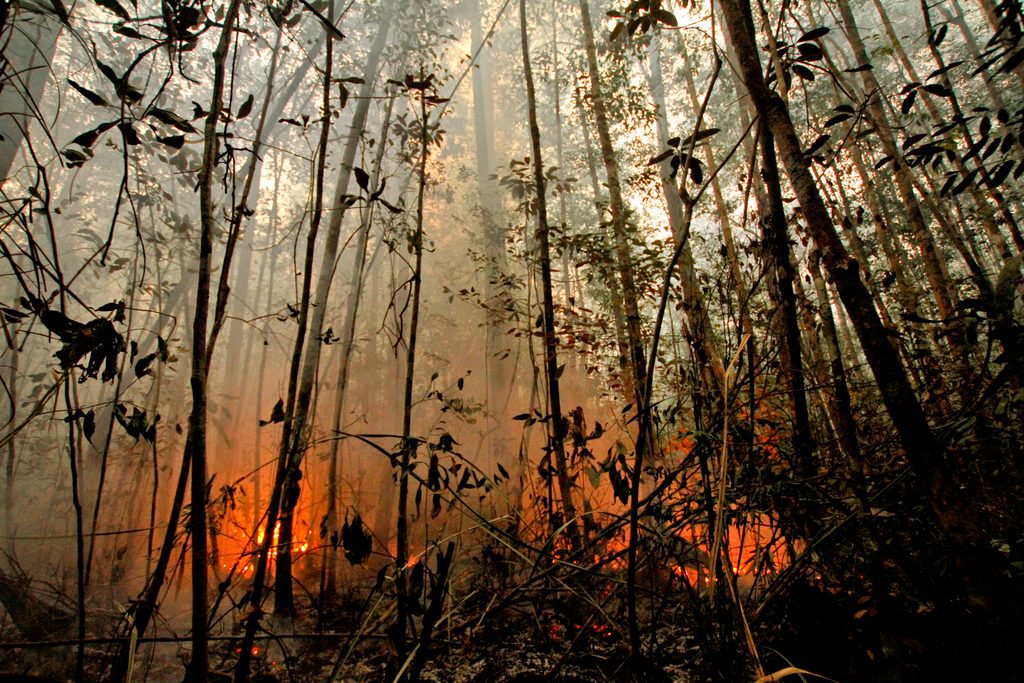
Fires have been burning across Sumatra and Kalimantan since the dry season began in July 2026. This year the dry season has been lengthened and intensified by a strong El Niño, leaving peatlands exceptionally dry. Most fires are burning on degraded, drained peatland, which is highly flammable once dried out and can smoulder underground for weeks. Official Ministry of Forestry data show that 202,004 hectares had already burned between January and July, 47% more than in the same period of 2019,[1] and fire activity has increased sharply since then. On 20 September the Ministry recorded 1,532 high confidence hotspots nationally, 968 of them in Central Kalimantan and 285 in South Sumatra, followed by West Kalimantan, South Kalimantan and Jambi. Since August, the Indonesian government has deployed 64 aircraft and more than 54,000 personnel from the Ministry of Forestry’s Manggala Agni fire brigade, the armed forces, police, disaster management agencies and local government.[2] Fires are expected to continue until the rains return in late October or November.
Impacts on gibbons and their habitat
The fires are burning in the habitats of five gibbon species, all listed as Endangered on the IUCN Red List. The Bornean white-bearded gibbon (Hylobates albibarbis) is of greatest concern. It is found nowhere else on Earth than south-west Borneo, between the Kapuas and Barito rivers, almost entirely within Central and West Kalimantan, the two Bornean provinces worst affected this year. Central Kalimantan alone accounted for nearly two-thirds of all hotspots recorded in Indonesia on 20 September. The affected provinces also include parts of the ranges of two other Bornean endemics, Müller’s gibbon (Hylobates muelleri) and Abbott’s grey gibbon (Hylobates abbotti), while on Sumatra the fires are burning within the ranges of the agile gibbon (Hylobates agilis) and the siamang (Symphalangus syndactylus).
Fires have been reported in, or at the edges of, several protected areas that are strongholds for white-bearded gibbons. In Tanjung Puting National Park, Ministry of Forestry data show that more than 4,500 hectares had burned by 13 September.[3] Fires have reached the edge of Sebangau National Park, home to the largest known population of the species, where government fire crews, the armed forces, police and the regional disaster management agency are working to stop them spreading into the park.[4] In West Kalimantan, fires have also reached Gunung Palung National Park.[5] Many hotspots have also been detected outside protected areas, in forests managed for timber, ecosystem restoration and other uses, which together support a large share of the remaining gibbon population on Borneo.
On Sumatra, South Sumatra has the second highest number of hotspots in Indonesia, and fires are also burning in neighbouring Jambi. In Berbak National Park, which supports agile gibbons, fires in remote peat-swamp forest have been so difficult to reach on foot that they are being fought mainly from the air, by water bombing and weather modification.[6] The lowland forests of South Sumatra and Jambi lie within the ranges of both the agile gibbon and the siamang, which have already lost much of their lowland habitat to forest conversion and past fires.
Peat-swamp forest is highly flammable once degraded and drained, and fires here can burn for weeks, destroying habitat that will take centuries to regenerate naturally. Gibbons almost never come to the ground, so they cannot easily cross burned or open land to escape the flames. Those that survive are often left stranded in small, isolated patches of forest with too little food and no way to disperse.
Gibbons are highly vocal animals, and their loud morning songs are central to defending territory, maintaining pair bonds and locating mates. During the 2006 Kalimantan fires, gibbons were found to call less often and sing shorter songs on smoky days.[7] Reduced singing during heavy smoke is consistent with respiratory irritation, and a comparable pattern has since been documented in wild apes in the same forests.[8] Gibbons breathe the same smoke-laden air as the people living alongside them, and there is every reason to expect they suffer similar respiratory harm, on top of habitat loss and disruption to the behaviours that keep wild populations viable.
Impacts on people
The fires and smoke are also harming the health and livelihoods of people living in and around the affected landscapes. Respiratory illness has increased, schools have closed and daily life and local economies have been disrupted. These impacts fall hardest on children, older people and those with existing respiratory conditions, and on rural and indigenous communities living closest to the fires.
What is needed
The SSA calls for these fires to be brought under control as swiftly as possible. Fires on this scale threaten globally important gibbon populations, damage carbon-rich peatland that will take centuries to recover and put the health of millions of people at risk. With fires forecast to burn for at least another month, the coming weeks are critical.
The SSA asks the international community to stand with Indonesia in responding to this fire season: technical and financial support for firefighting and peatland rewetting, investment in early warning and hotspot monitoring, and long-term funding for community-led fire prevention in the landscapes where gibbons and people share the same forests. Protecting fire-prone peat-swamp landscapes protects gibbons and the people who live alongside them. This call is consistent with Resolution 8.115, Strengthening gibbon conservation through collaboration and synergy, adopted by IUCN Members at the 2025 World Conservation Congress in Abu Dhabi, which commits the international community to greater collaboration, funding and habitat protection for gibbons, including preventing the habitat loss that fire causes.[9]
[1] Ministry of Forestry, Republic of Indonesia. SiPongi+ Indikasi Luas Kebakaran Hutan dan Lahan, January to July 2026. https://sipongi.gakkum.kehutanan.go.id/indikasi-luas-kebakaran (accessed 23 September 2026).
[2] Ministry of Forestry, Republic of Indonesia (21 September 2026) Pengendalian karhutla Kalteng-Sumsel diperkuat; 64 armada udara dikerahkan. https://www.kehutanan.go.id/news/pengendalian-karhutla-kalteng-sumsel-diperkuat-64-armada-udara-dikerahkan
[3] Tabengan (September 2026) Sudah 4.524 hektare hutan Tanjung Puting terbakar, citing Ministry of Forestry data. https://www.tabengan.co.id/bacaberita/145268/sudah-4-524-hektare-hutan-tanjung-puting-terbakar/
[4] Tabengan (8 September 2026) 800 hektare lahan terdampak, karhutla ancam Taman Nasional Sebangau. https://www.tabengan.co.id/bacaberita/144666/800-hektare-lahan-terdampak-karhutla-ancam-taman-nasional-sebangau/
[5] Dickie, G. (16 September 2026) Indonesian wildfires threaten leading orangutan research site in Borneo. The Guardian.
[6] ANTARA (21 September 2026) Satgas: pemadaman karhutla TN Berbak hanya bisa lewat udara dan OMC. https://www.antaranews.com/berita/5751236/satgas-pemadaman-karhutla-tn-berbak-hanya-bisa-lewat-udara-dan-omc
[7] Cheyne, S.M. (2008) Effects of meteorology, astronomical variables, location and human disturbance on the singing apes: Hylobates albibarbis. American Journal of Primatology, 70(4), 386-392.
[8] Erb, W.M., Barrow, E.J., Hofner, A.N., Lecorchick, J.L., Setia, T.M. and Vogel, E.R. (2023) Wildfire smoke linked to vocal changes in wild Bornean orangutans. iScience, 26(7), 107088.
[9] IUCN (2025) Resolution 8.115, Strengthening gibbon conservation through collaboration and synergy. World Conservation Congress, Abu Dhabi. https://portals.iucn.org/library/sites/library/files/resrecfiles/WCC_2025_RES_115_EN.pdf